Showing posts with label Shenette. Show all posts

The Life of a Laundress: Steam Laundry Work in 1908

(Copyright (c) 2015 Cynthia Shenette) One of my tasks at my library job is to put away closed stack material.  I love it, because I often find interesting stuff that I would never come across otherwise.  Last week I was putting away some closed stack material and came across a volume of the journal Charities, published by The Charity Organization Society, 105 East 22nd St., New York, NY.  Charities was published from 1897-1952 with several name changes over the course of its publication. 

The volume that I looked at had sections on a number of different topics I think might be of interest to genealogists and family historians.  Topics included articles on the following: civic improvement; child labor; communications and conferences; "defectives" and dependents; delinquents; housing; immigration; industrial education; juvenile courts and probation; milk; organized charity; play, playgrounds, and parks; saloons and prohibition; schools; schools of philanthropy; settlements; social forces; tuberculosis; and unemployment. 

While there were a number of articles that I found interesting one in particular caught my eye. "Pittsburgh's Steam Laundry Workers" by Elizabeth Beardsley Butler.  My grandfather's sister, Lena (Chenette / Shenette) Potvin (1882-1961) spent time working in a steam laundry in Worcester, MA from 1909 to 1913.  While the article I read in Charities was specific to Pittsburgh, I'm sure many things about the Pittsburgh article also applied to the way steam laundries were run outside of Pittsburgh as well.


"The modern steam laundry is the latest instance of the routing of a home industry."

Laundry was, as it still is, a constant of everyday life.  Commercial laundries processed laundry from hotels and factories, from railroads and from private homes, with the majority of laundry workers being women. Most laundry workers were young and unskilled and the ones who flourished in the laundry business, if one could possibly flourish in such an environment, had a knack for speed within their assigned task.

Steam laundries had several departments--checking and sorting, washing, mangling, starching, and ironing.  The working conditions varied from department to department, and differences in mental and physical demands called for differences in personnel.

Checkers received a batch of linens and marked each article with the owner's name and sorted into baskets items to be washed separately--colored goods, flat work, shirts, collars, fancy articles, etc. Checkers were the lucky ones in a commercial steam laundry environment.  The job was easier, and they were able to dress better because they didn't need to slave over hot, steamy laundry all day.  A checker was considered to be an "aristocrat" among laundry workers.


"At the preliminary processes of washing, mangling, and starching, place is found for the beginners and the girls of the lowest grade."

The washroom was generally the men's part of the laundry.  Strong men were needed to operate the washing machines which were huge cylinders full of hot water and steaming clothes, though some women were used in the washing room for pieces better done by hand, such as flannel.  Laundry was put in extractors which twisted the clothes and flung the water out of the wet material by centrifugal force, then garments were moved into trucks and wheeled to metal wringers.

Before laundry could be fed into the mangle "shakers-out" untwisted and unknotted the laundry to be fed into the mangle.  Shakers-out tended to be new female workers, young girls, and older women not physically capable of other jobs.  Once the laundry was shaken out, feeders stood at one end of the mangle and pushed the flat goods over the metal apron until the rolls caught them.  Steam heat heated the metal mangle rolls.  


Feeders had the most dangerous job.  By 1908 the mangle had a "guard," small rolls that were hot at the beginning of the mangle to catch the feeder's attention before the feeder's hand was caught in the mangle.  In the past hands and arms were caught, crushed, and maimed in the mangle. Sometimes several girls were needed to feed larger pieces of cloth into the mangle.  Mangle girls were the youngest as the work required the least amount of training.  As a result the pay rates for mangle girls were the lowest.

In the starching room trays of boiling starch were ready for collars, cuffs, and anything else that needed to be starched.  There were three groups of machines--a collar starcher, a shirt bosom starcher, and a band starcher.  The collar girl fed collars or cuffs into the machine that carried the linen by a conyeyor to make contact with rolls immersed in hot starch.  Wipers wiped in starch with their hands.  The starch room machines were largely automatic, with little skill or experience needed.


"No American can stand this.  We have to use Hungarians or other foreigners."

In the ironing room there were long rows of machines.  Each girl was a specialist at her own machine.  She did not iron a whole article, instead she ironed a sleeve or a cuff or a yoke, or perhaps one side of a collar.  There were two different kinds of machines--steam presses and rolls.  A "body ironer" was so difficult one man said he would not hire a girl for the body ironer unless she weighed 180lbs because of the strength and size needed to operate the machine.  With the cuff press machine the whole body of the girl shook with the force she needed to use the machine.  Cuff pressers ironed at the rate of three cuffs a minute which meant twelve of the violent motions each minute for a total of 7,200 treadle pressures a day.  Fancy ironer's worked almost exclusively in women's wear.


"The work's too hard, and you simply can't stand the heat."

Most workers didn't last in a commercial laundry too long.  The emphasis was on speed.  Washroom floors were wet.  Gutters ran under the washing machines to carry off waste, but water still could stand in pools where the floor had sunk in places. There were clouds of steam, inadequate ventilation, and the heat was intolerable, with steam rising from the boilers ten hours a day.  Windows were small, ceilings were low, and fans were few.  In Pittsburgh women made a dollar a day for a ten hour work day.  Laundry owners preferred hiring women, because they could hire two women for the same money they would spend on one man.  Laundry workers had a tendency to get tuberculosis.  All in all, workers generally didn't last long in the industry, four years on average though many didn't make it to two.

So tonight when you go home and decide to toss a load of laundry in before bed, don't complain about having to haul your laundry up and down from the basement or wherever your washer and dryer are located.  Think about how easy you have it compared to your ancestors.  Thankfully, for my dad's Aunt Lena she didn't work in the laundry business all that long.  Eventually, Lena married Joseph Potvin and moved to St. Albans, VT where she operated a beauty shop.  While it probably wasn't exactly picnic cutting ladies' hair and giving perms all day every day, I bet it was still a lot easier than her time working as a "laundress."

Source: Butler, Elizabeth Beardsly. "Pittsburgh's Steam Laundry Workers,"  Charities, 20 (1908): 549-63.


Other Posts You Might Like:

Business Profile: Helen's, 39/41 Millbury St., Worcester, MA
Four Wives and 24 Children: A Demographic Study
Reflecting on My American Experience this Thanksgiving
PhotoStory: Dad and a Mystery Solved

Flash Back! The Life and Times of Francois Chenet (Greatly Abridged)

(Copyright (c) 2012 Cynthia Shenette) Well, it's Carnival of Genealogy time again, and our assignment for this month is to create a "flash" family history of one of our ancestors in 300 words or less.  I decided to write about my great-grandfather Francois Chenet.  To use Francois as the subject for my flash family history is absurd to say the least, given the...um...details of Francois' life, but the concept was both fun and challenging.  Let's just say I tried my best to capture the highlights (cough) of Francois relatively long life.  While my flash family history is short, I think I've done a reasonable job in capturing the essence of the man.  What do you think?

Francois Chenet (18 Apr 1813- 22 Mar 1886)

My great-grandfather Francois Chenet was born in St-Denis-sur-Richelieu, Quebec in 1813.  He married Marie-Marguerite Charron in 1836.  Their first child Marguerite was born in 1837.  Their second child Justine was born in 1839. Their third child Jean-Baptiste was born in 1840.  Their fourth child Julienne was born 1841.  Their fifth child Celina was born in 1842.  Their sixth child Philomene was born in 1844.  Their seventh child Francois was born 1845. Their eighth child Marie-Reine was born in 1847. Their ninth child Marie-Vitaline was born in 1848.  Their tenth child Joseph was born in 1849. In 1850 Marie-Marguerite died.

Francois married Theotiste Tetreault (1852).  Their first child Francois-Xavier was born in 1852.  Their second child Louis was born in 1854. Their third child Louis-Napoleon was born 1856.  Their fourth child Toussaint was born in 1858.  In 1859 Theotiste died.

Francois married Marie-Louise Dubreuil (1859).  Their first child Marie-Louise-Delima was born in 1860.  Francois enlisted in the Union army (1863).  Their second child Marie was born in 1864.  Francois was wounded at Cold Harbor (1864). The Civil War ended (1865).  In 1866 Marie-Louise died.

Francois married my great-grandmother Lucie Touchette (1867).  Their first child Victorine-Lucy was born in 1868.  Their second child Francois-Adei was born in 1871.  Their third child Joseph-Theodore-Hormidas (my grandfather, who became Frank.  Go figure...) was born in 1873.  Their fourth child Joseph was born in 1874.  Their fifth child Marie-Josephine was born in 1876.  Their sixth child Flavi-Joseph was born in 1878.  Their seventh child Francois-Elzear was born in 1879.  Their eighth child Marie-Delina-Vedora was born in 1882.  Francois died in 1886.

And the women of Quebec breathed a collective sigh of relief...

Submitted for the 115th edition of the Carnival of Genealogy.


Other Posts You Might Like:

Tombstone Tuesday: Francois Chenette, Civil War Soldier
Photo Story: Dad and a Mystery Solved
Fascinating Ladies
More Than Meets the Eye (Again): A Tuesday's Tip Follow Up!

A Charlie Brown Tree, All Grown Up - Wordless Wednesday

Cynthia Shenette and Henry Shenette
(Original Images and Text, Copyright (c) 2011 Cynthia Shenette) What the heck is going on with that tree?  It kind of reminds me of Charlie Brown's Christmas tree except bigger.  I look as if I'm about two in the photo. We didn't have any pets at time so I can't blame the mess with the tinsel on a cat or a dog. Hmm.  I wonder what got into the tree?  Me perhaps? That might explain the grumpy little look on my face.  An attitude adjustment definitely seems to be in order.


Clearly I am much happier in this photo.  There's nothing like a new set of wheels to put a smile on one's face!


Other Posts You Might Like:

What The Dickens, Or How to Blow Up a Duck - Advent Calendar, Holiday Foods
Advent Calendar: Christmas Cards from Poland and Germany
(Almost) Wordless Wednesday: Me and My Doll
Not So Wordless Wednesday: Me, Our Tree, and Another Doll

Photo Story: The End, For Now

Antonina (Bulak) Szerejko and Cynthia Shenette
(Original Image and Text, Copyright (c) 2011 Cynthia Shenette) This is where my story ends, at least for now.  It's been an interesting journey, and I've learned a lot.  History isn't simple and can't be defined only by the famous.  More often than not history is made up of ordinary people doing ordinary things, though sometimes life circumstances result in ordinary people being called upon to do extraordinary things.  We are all unique, and thank goodness for that.

You've read my story.  What's yours?


Other Posts You Might Like:

Heritage Zen Dives In: NaBloPoMo!
Meditation: The Strength of Ordinary Women
The Stories My Grandmother Told Me
Reflecting on My American Experience this Thanksgiving

Photo Story: Passages

My Grandparents, Antonina (Bulak) Szerejko and Adolf Szerejko
(Original Image and Text, Copyright (c) 2011 Cynthia Shenette) The 1950s was a decade of joy and sorrow in the extreme for my family.  My mother and her siblings were married and my grandparents were enjoying their new role as grandparents.  My grandfather was soon due to retire at 65.  He and my grandmother had purchase a property in 1940 with three acres of land in a still rural part of Worcester.  Their intention was to start a plant and flower business for their retirement years.  Gardening was one of their joys in life. You can see one of my favorite photos of my grandparents and their flowers here.

Their plans were disrupted and their joy turned to grief with the sudden, tragic death of one of my mother's siblings in 1955.  I truly believe it was a loss neither my grandmother nor my mother for that matter, recovered from.  Grief also took it's toll on my grandfather.  My mother said she always believed the stress of that loss contributed to my grandfather's death at the age of 64 in 1959 just before his retirement.  In addition to the losses on my mother's side of the family, my Dad's mother, Marie (Comeau) Shenette LeMay also died in 1959.


Other Posts You Might Like:

The Stories My Grandmother Told Me
My Grandmother - Wordless Wednesday
Girls Just Wanna Have Fun...
Wordless Wednesday: June is Wedding Month at Heritage Zen

Photo Story: Peace and Changes

My Mother's Cousin Celina (Szerejko) Gzell and Son, Warsaw, Poland, Late 1940s 
(Original Image and Text, Copyright (c) Cynthia Shenette) For the family in Poland post World War II was a time of change and upheaval.  My grandfather Adolf's brother Feliks and his wife were civilian casualties of the war.   Their children survived however.  One son served in the Polish Army and was captured by the Germans.  He eventually ended up in a DP camp in Germany after the war and stayed there until he was allowed to immigrate to the United States.

My grandfather's brothers Henryk and Jan survived the war.  Jan lost one son to Soviet violence shortly after the war.  The Soviets were not friends of the Polish people.  A letter from one of  my grandfather's relatives said that to remain in Soviet occupied Poland would be "a slow starvation." Given the family letters that I've read I've always felt that post traumatic stress disorder was probably epidemic within the civilian population after World War II and not just a problem for those in the military.

My Dad and his three brothers who served overseas returned to the United States.  Their father Frank Shenette died in June of 1945 just before the end of the war.  My mom told me that my dad participated in one of the ticker tape parades in New York City.  Apparently he was qualified to operate a tank from his training in the Army and was chosen to drive a tank during the parade.  After the war Dad reenlisted into the Navy where he served until he retired from the military in 1957.

Mom's job at the Ration Board ended with the conclusion of the war.  She found work at the local office of the United States Department of Agriculture (USDA) in the Federal Building in downtown Worcester where she worked until she married my dad in 1953.


Other Posts You Might Like:

Chopin Rising
Post World War II "Care" Packages - Amanuensis Monday
Where They Lived: Every Address Tells a Story
Leokadia (Szymanska) and Feliks Szerejko - Wordless Wednesday

Photo Story: Changes and World War II Begins

Mom's 1940 Yearbook Photo
(Original Image and Text, Copyright (c) 2011 Cynthia Shenette)  The end of the 1930s and the early 1940s was a time of change for my family.  In 1939 my grandfather's brother Feliks was killed in the bombing of Warsaw on the first day of World War II, and my great-grandfather Antoni died during the winter of 1940.  Mom graduated from high school in the spring of 1940 and went on to continue her education at a two year business college.  

After college Mom worked at the Worcester War Price and Rationing Board for the duration of the war.  She enjoyed working at the Ration Board and said it was the best job she ever had.  She must have done a pretty good job, because she was eventually put in charge of the food and shoe departments.  

Dad returned from the Philippines and was separated from the service in California on November 19, 1941.  Pearl Harbor was bombed eighteen days later on December 7, 1941.  Dad knew it was a matter of time before he was drafted, so he reenlisted in February of 1942.  This time around he chose to serve in the Navy.  He figured if he reenlisted he would get to choose which branch of the military to serve in.  If he waited for the draft he would be assigned to a branch.  He always said if worse came to worse he'd rather go down with the ship than die in a foxhole.  He was in the Navy for 15 years and never learned how to swim...  


Other Posts You Might Like:

Remembering Pearl Harbor
Reflecting on My American Experience This Thanksgiving
Not So Wordless Wednesday: It's Costume Month at Heritage Zen!
Where They Lived: Every Address Tells a Story

Photo Story: Dad and A Mystery Solved


(Original Image and Text, Copyright (c) 2011 Cynthia Shenette) My mom grew up in the Vernon Hill section of Worcester.  My dad also grew up in Worcester.  

This is the only photo I have of my dad, Henry Albert Shenette (1916-1985), and his siblings as children and young adults.  This photo was taken in 1929 and includes six of my dad's seven siblings.  Sibling number seven hadn't been born yet when the picture was taken.

While I have hundreds of photos of my mom's family I have very few of my dad's family. Why is this?  I believe there are a number of reasons.  Money was tight for Dad's family.  My grandfather Frank Shenette (1873-1945) is listed in the census and the Worcester city directories as a painter or a house painter.  If you compare the economic downturn of today in relation to the Great Depression, painting is something that you can often do without when money is short.  My grandmother, Marie Louise (Comeau) Shenette (1890-1959), was busy with the children, giving birth approximately every two to three years between 1907 and 1929.  The family moved around a great deal, probably due to work and the cost of rent.  From the time my dad was born in 1916, until he left home for the Civilian Conservation Corps in 1934, the family lived in eight different places in Worcester. My dad also spent many years traveling in the military.  Finally, there were eight children to divide up the existing photos.

I posted this photo back in February of this year.  At the time I listed the names of all of the siblings, but I didn't know the identity of the older woman in the group.  I remember asking my dad years ago who she was and all he said was that she was an aunt. I speculated that the woman might have been Frank's sister Josephine (1876-1952) who I mention in my post, The Death and Funeral of Charles Senecal - Amanuensis Monday.  The woman resembles members of the Chenette family.  Josephine lived in Worcester, and would have been about the age of the woman in the photo.  I am happy to report  that I have discovered the identity of the woman in the photograph.  The mysterious "aunt" is Lena (Chenette) Potvin (1882-1961) Frank's youngest sister.  I initially discounted Lena as she lived in St. Albans, VT at the time the photo was taken. I had the right side of the family, but the wrong sister.  Special thanks goes to my cousin Roger LaFerriere who found my blog online, took the time to contact me, and solved the mystery!

The siblings in the photo are Leo A. (1907-1973), Edward F. (1911-1991), Margaret M. (1913-2004), Richard R. (1922-1980), Dad, Bertha L. (1910-1991), and Raymond F. (1925-1990) sitting in Lena's lap.  You may notice that throughout this post I use both the Chenette spelling and the Shenette spelling.  The spelling varies between records and even between siblings.


Other Posts You Might Like:

What's In A Name? (An Ongoing Series): Chenette
Tombstone Tuesday: Francois Chenette, Civil War Soldier
Wordless Wednesday: Dad, Somewhere Cold
Postcards From the Edge: Genealogy Road Trippin'

Happy Birthday Mom - Wordless Wednesday


(Original Image and Text, Copyright (c) 2011 Cynthia Shenette) This was the first birthday cake I made for my mom.  As you can see I had a little, uh, issue with the frosting.  Luckily my cake decorating skills have improved over the years.  My mom would have been 90 today.  There isn't a day since she died that I don't think of her or miss her.  Happy Birthday, Mom.  Love you.


Other Posts You Might Like:

Meditation: The Strength of Ordinary Women
A Pretty Girl on Old Cape Cod
Girls Just Wanna Have Fun...
Wordless Wednesday: A June Wedding

The Worcester Tornado, June 9, 1953 - Those Places Thursday

The tornado from the eastern shore of Indian Lake.
(Copyright (c) 2011 Cynthia Shenette; Photo is not under copyright and is available from the Internet Archive.) According to Mom June 9, 1953 was a hot day.  A really hot day.  She left work and was walking from her office in the Federal Building up Main Street to the bus stop in front of Barnard's department store when the sky started to get dark.  When she heard thunder she decided to wait at the front of the store under cover, because rain seemed imminent.  It wasn't long before the rain started. 

Even fifty years later she remembered the storm, vividly.  She described it as a "a wild storm" with a black sky, thunder, lightening, and an intense driving rain.  It was nothing like she had ever seen before.  When the storm finally stopped she started to hear sirens.  Lots of them.  One after another.  Emergency vehicles--police cars, fire trucks, ambulances--racing up Main St. to the north part of the city.  She said it wasn't long before emergency vehicles began to return back down Main St., sirens still blaring.  Again, fifty years later, my mom's most vivid memory besides the storm itself, was of seeing pick-up trucks carrying dozens of bloody, wounded people down Main St. to hospitals around Worcester.  There were too many injured people and not enough ambulances to transport everyone.

When my mom finally did get home she was relieved to find everything was okay.  My grandmother, who was at home at the time, described an awful storm.   The family home, the home where I later grew up, was near Indian Lake in Worcester.  My grandmother said that after the storm passed, she looked out at the lake and saw huge, churning waves like you might see on a stormy day at the ocean.  My mother and her family still had no idea what had happened.  They didn't know that a massive tornado, one mile in width, had just blown through the city less than two miles away from their home.  They were the lucky ones. 

For my family the tornado was a close call, and given the losses other people suffered, more like an inconvenience.  My parents wedding was scheduled June 13, and there was some doubt as to whether they would be able to hold their wedding reception in Sterling, two towns north of Worcester.  The wedding guests were able to drive around and through the areas of destruction, and the reception went on as scheduled.

The Worcester tornado left a path of destruction through Petersham, Barre, Rutland, Holden, Worcester, Shrewsbury, Westboro, and Southboro.  A second funnel cloud spun off the initial storm near Grafton to travel southeast eventually ending in the Wrentham area.  When all was said and done 94 lives were lost, 15,000 were left homeless, 4,000 homes were destroyed, and the storm did damage to the tune of $53 million, in 1953 dollars.

My mother said that no one had ever heard of a tornado in Massachusetts.  Certainly not one with that kind of power.  Tornadoes were not classified according to the current Enhanced Fujita Scale in 1953 as they are today.  The Worcester tornado is currently classified as a EF4, though I have heard that it was a strong F4, possibly even an F5.  Last week's devastating series of tornadoes in Massachusetts are a painful reminder, that yes, it can happen here.

Tornado!: 84 Minutes, 94  Lives, is a wonderful book written by local Worcester author John M. O'Toole.  The book, written in 1993 and still available through Amazon, is an "...eyewitness story of the tornado with the highest winds ever recorded," a true statement when the book was published.  The record for highest winds stood until the Oklahoma City tornado of 1999.  Heather Rojo of Nutfield Genealogy wrote a great post a couple of weeks ago about the Worcester Tornado.  I also invite you to read Susan Clark's wonderful post, Our Places - Those Places Thursday if you haven't already.  Her post is one of those pieces that makes me want to say, "What she said..."  Finally, the American Red Cross of Central and Western Massachusetts is accepting donations for tornado disaster relief.  Please donate if you can.

Yes, it can happen here...


Other Posts You Might Like:

Where I Grew Up - Wordless Wednesday
The Stories My Grandmother Told Me
Fascinating Ladies
COG 97: Researching "The Coldbrook Tragedy" (Part 1 of 4)

The Shenette Family - Wordless Wednesday

(Original Image and Text Copyright (c) 2011 Cynthia Shenette) This is the only photo I have of my father as a child and the only one I have of him and his siblings together. My dad, Henry A. Shenette (1916-1985), is the boy with the knickers at the bottom. I think he was about 13 when this photo was taken. Pictured clockwise from the top are Leo, Edward, Margaret, Richard, Henry (dad), and Bertha. Raymond is the little boy in the woman's lap. There was one more sibling, not shown, who was probably not born yet when this photo was taken, for eight in all. I don't know who the older woman in the middle is. I remember years ago I asked my dad if she was his mother, and he said no. He said she was an aunt. No name was mentioned. I don't know for certain, but she might be Josephine, their father Frank Shenette's sister. I mentioned Josephine in my Amanuensis Monday post, The Death and Funeral of Charles Senecal. I know Josephine lived in Worcester at the time this photo was taken, and the woman looks as if she could be the right age. There is also a Shenette family resemblance.


Other Posts You Might Like:

Wish You Were Here?
Where I Grew Up
(Not So) Wordless Wednesday: The Kowalewski Family
(Almost) Wordless Wednesday: Alsatian Girls

The Death and Funeral of Charles Senecal - Amanuensis Monday

(Copyright (c) 2011 Cynthia Shenette)

Amanuensis: A person employed to write what another dictates or to copy what has been written by another.

Thanks to John Newmark at
Transylvanian Dutch for providing the idea for Amanuensis Monday.

I learned of the circumstances of Charles Senecal's death as I was doing some research for a genealogy friend of mine. Charles Senecal was my friend's great-uncle and his wife Josephine was my grandfather Frank Shenette's sister. My friend's understanding was that Charles was a fireman and had died in a fire. Interestingly, both things were true, however he was not a fireman as we might think of a fireman today. He was a fireman who worked with boilers. This discovery was a surprise to both of us, and taught me valuable lesson. Job descriptions have changed over the years. What you think might be someone's occupation according to today's standards might actually be something very different given the standards of the day. A side note, Charles sister, the Mrs. Thomas Shenett mentioned, was my grandfather Frank Shenette's sister-in-law. She was married to Frank's brother Thomas.

St. Albans Daily Messenger. Tuesday, April 18, 1905, p 7.

FUNERAL OF CHARLES SENECAL

_____

Details of Accident Which Resulted in His Death.

The body of Charles Senecal, who died Sunday in the city hospital in Worcester, Mass., arrived in this city on the 4:55 o'clock train this morning and was taken to the residence of his sister, Mrs. Thomas Shenett, of Elm st. The body was accompanied by Mr. Senecal's brother, Michael Senecal of Worcester. Mr. Senecal is survived by his wife, a year-old-son, his mother, Mrs. Lucy Senecal, of this city, and one sister, Mrs. Thomas Shenett, of this city. The f[u]neral will be held at 9 o'clock to-morrow morning at the Holy Angels church. The burial will be in the Mount Calvary cemetery.

Following is an account of the accident to Charles Senecal, of Worcester, Mass., which caused his death. Mr. Senecal as noted in last night's Messenger died Saturday at the City hospital in Worcester, Mass., and the account of the accident is taken from a Worcester paper:

"Charles Senecal, thirty-one years old, engineer at the Baker Lumber Co., 26 North Foster st., was severely burned on both legs and around his waist, while at work cleaning a boiler. He was taken to City hospital in a police ambulance.


"His wife is at the hospital, recovering from an operation which was performed last week. It is thought that she is now out of danger.

"Senecal had taken out the grate and lining of the boiler, and the fire had been dumped, when, according to his story to the police, he ordered his helper to fill the ash pit with water. He donned a pair of old shoes and trousers and went to the boiler to get into the ash pit and clean out the bottom of the boiler.

"He said he thought the pit had been filled with water, and that the ashes were cold. He jumped into the pit into hot water and hot ashes up to his waist. He was hauled out by his helper, suffering severely from burns which covered his waist and legs to his feet.

"A police ambulance was called, and officer Oliver Blake and driver Edward Wilson covered the man's burns with carron oil, which relieved the pain, and hurried him to City hospital.

"Senecal said that not as much water had been turned into the pit as he had thought, and that the ashes were not cooled as much as he believed they would be.

"When he got to the hospital, his first questions were for the condition of his wife, and this appeared to trouble him more than his own injuries. He felt better when he found his wife was in a comfortable condition. They live at 16 Bancroft st.."


Other Posts You Might Like:

Flu 1918 (Part 1 of 3)
Amanuensis Monday: Clairvoyants and Distractions
Amanuensis Monday: Frank L. Naramore Obituary
Madness Monday: The Stuff We Throw Away, and...

Wordless Wednesday: A June Wedding


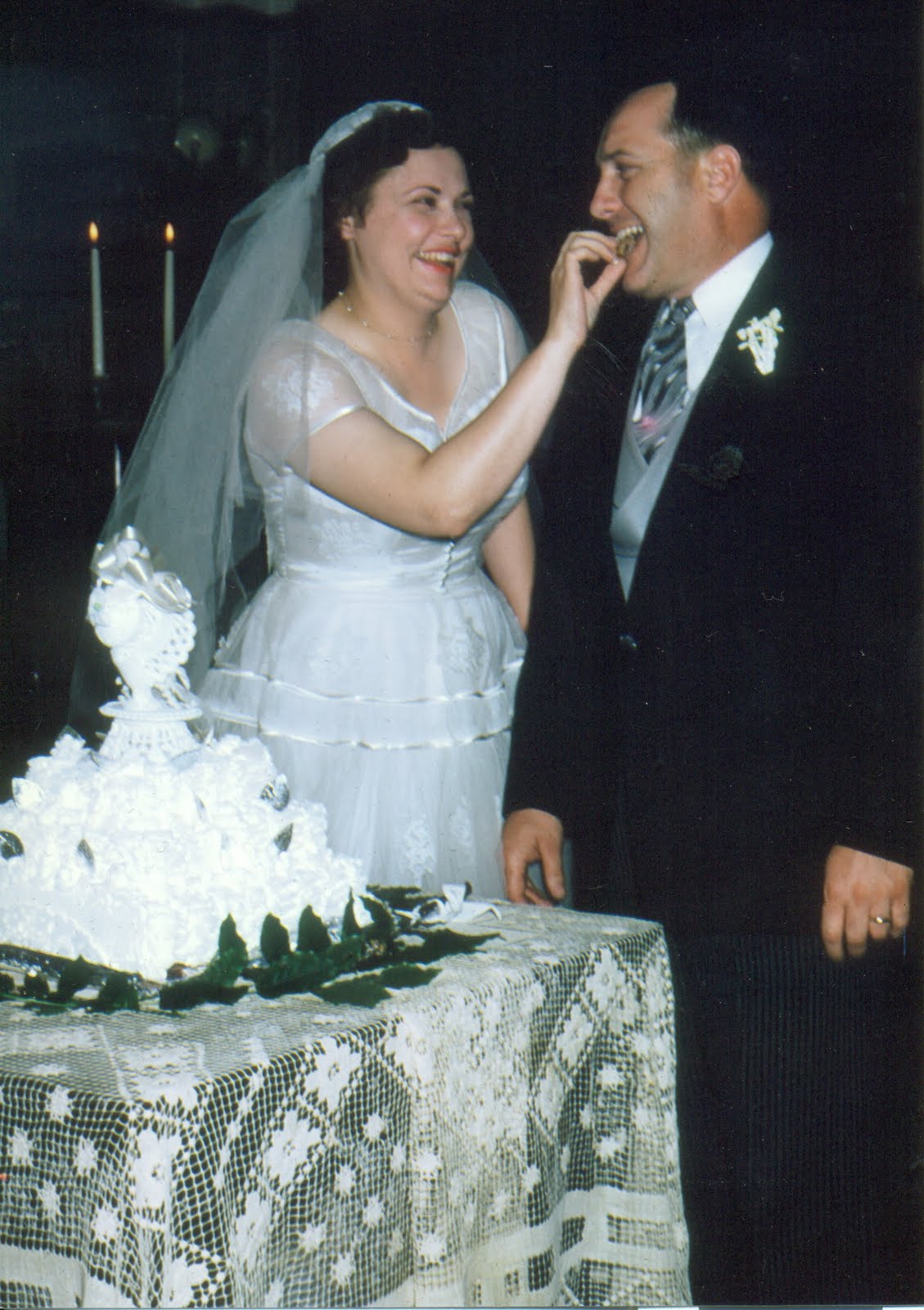
Mom and Dad (Christine Szerejko and Henry Shenette) on their wedding day, 13 Jun 1953. The ceremony took place at St. Mary's Church, also known as Our Lady of Czestochowa in Worcester, MA, and was followed by a reception at the Sterling Inn in Sterling, MA. My grandmother Antonina Szerejko made the dress and the cake. The cake was a European fruit cake.

What's In A Name? (An Ongoing Series): Chenette

No offence to William Shakespeare, but a name means plenty if you are a genealogist. I like to say I come from a long line of misspellers. My last name, Shenette, should be spelled Chenette. I've corrected people trying to spell my name the "correct" way dozens, if not a hundred times over the years.

My father had five brothers and two sisters, eight in all including my dad. Some of the siblings spelled their last name beginning with C and some with an S. How did this particular spelling debacle come about? I was told a couple of different stories. One was that my grandparents were illiterate when they first came to Vermont and then Massachusetts from Quebec. They were dependant on the clerk at Worcester City Hall to fill out the information on the birth certificate. The other was that the name was misspelled when some of the "boys" joined the military during World War II.

At any rate, misspelled surnames seem to to proliferate in my family. In various records--including census information, city directories, birth and death records, and cemetery records--I've found a long list of misspellings. I've found Shenette, Chenette, Chenet, Sinnett, Shinett. My paternal grandfather, Frank A. Shenette, started out life as Francois Hormidas Chenette. In the 1881 Canadian Census he is listed as Hormidas Chenette. Over the years I've found him as Francis, Hormidas, and Frank. He eventually seemed to settle on the name Frank Amidos Shenette. I've always wondered where the middle initial A came from on his death certificate and what the A stood for. The mystery was solved when I reviewed his World War I draft record. There he was, listed as Frank Amidos, with what I'm guessing to be a phonetic misspelling of Hormidas.

To add to the confusion my great-grandfather's name was also Francois. He was the father of 25 children (Yes you read that correctly. I'll deal with that issue in a separate post.). Apparently great-grandfather Francois really liked the name Francois. No less that three of his sons were also named Francois. I always joke that it reminds me of the characters on the old Bob Newhart show, "Newhart"--Larry, his brother Darryl, and his other brother Darryl (My great-grandfather Francois, his son Francois, and his other son Francois...). Sometimes the Francois went by their middle name, sometimes by Francois, sometimes Francis, or in my grandfather's case Frank.

What's a poor genealogist to do?


Surname variations for Chenette in my records: Chenet, Chenett, Chenette, Chuette, Schennette, Shenett, Shenette, Shinett, Shinnette, Sinnett.